America is in the throes of a serious cultural backlash being implemented not only by the Trump administration, but by Republican majorities across numerous states. Public schools are being defunded and restricted in what they can teach. Libraries are being censored and closed. Last week Donald Trump cut billions of dollars in funding to Harvard University and threatened several others. Museums, art programs, and media outlets are being cut or threatened.
All this is for the stated purpose of ‘protecting basic American values.’ What are those values? Well, apparently not freedom of speech and academic inquiry. I would have taken free speech as a bedrock American value. Wouldn’t you? Look at our founding documents: the Declaration of Independence, the Constitution, the Federalist Papers, the First Amendment. It’s in our songs and anthems. Aren’t we ‘the land of the free?’ Maybe we don’t really mean it.
The value of free speech is not absolute, after all. Other values can override it, like national defense, for example. So what is the value that is overriding our belief in the right and ability of libraries, schools, universities, museums, and media outlets to determine their own subject matter? (Let’s ignore Trump for now. The culture war didn’t begin and won’t end with Trump.) The answer is complicated, but it boils down to something like ‘protecting our way of life.’
Unfortunately, we Americans have never had a coherent view of what ‘our way of life’ is, exactly. It varies from place to place and from decade to decade or at least era to era. And that, (cultural change in particular) seems to scare people or infuriate them. We can’t even talk about it.
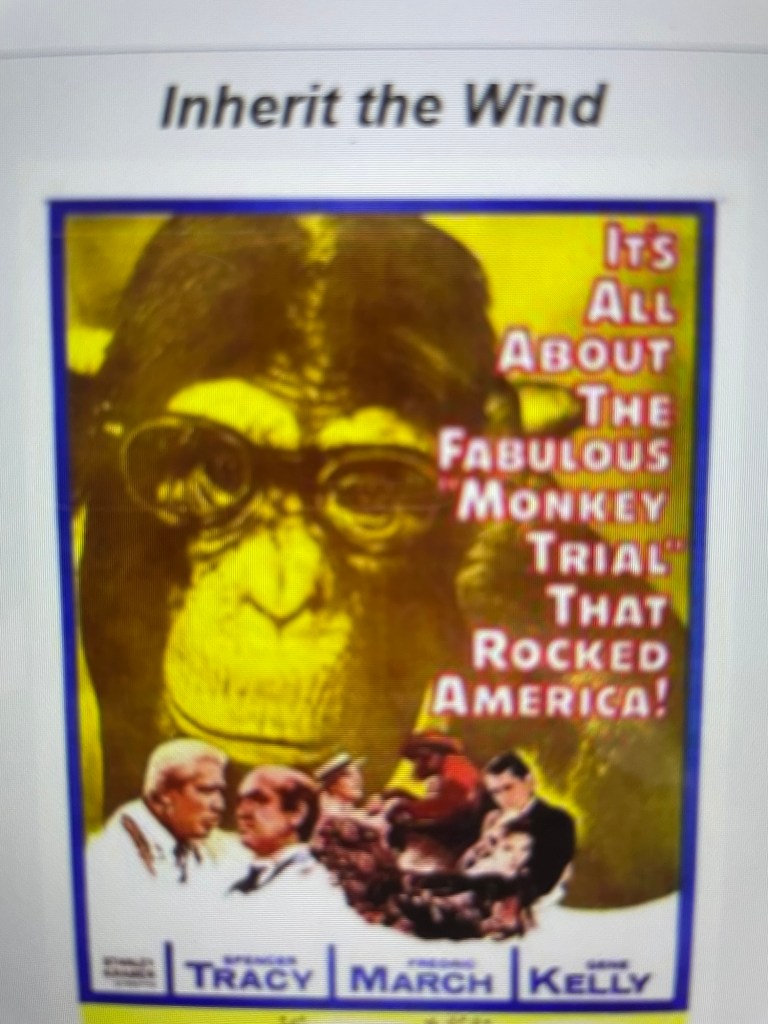
A good way to approach these issues without getting frightened or infuriated is with books or films. One of the best films ever made on the topic of free speech (as well as academic freedom and the culture wars) is Inherit the Wind. I personally like the original version from 1960, starring Spencer Tracy and Frederick March (but it has been remade several times, most recently in 1999.)
This is courtroom drama at its finest, based on the real and notorious Scopes trial in which John Scopes (a science teacher) was charged with violating a Tennessee law that prohibited teaching Darwin’s theory of evolution in the public schools in the 1920s. Sound familiar? How many states today are imposing legislative oversight and censorship of what teachers may present to their students?
The widely publicized case attracted legal heavyweights William Jennings Bryant (a presidential candidate, played by March) to prosecute Scopes, and Clarence Darrow (one of the most famous defense attorneys of all time, played by Tracy) to defend him. The town is strongly supportive of the prosecution. Led by their fiery fundamentalist minister, they are outraged that the lofty Christian values they taught their children are being threatened by an atheistic, so-called scientific theory that they think suggests we are descended from monkeys. Even the judge appears hostile to the defense, barring Darrow from calling scientific experts as witnesses. Left with no witness for the defense, Darrow calls Bryant (the prosecutor) to the stand as a self-proclaimed and widely recognized expert on the Bible.
He then proceeds to destroy Bryant’s (or anyone’s) ability to defend a literal interpretation of the Biblical creation story, which is riddled with contradictions and poetic allusions. Scopes loses his case (as well he should since he did violate the statute), but Darrow has used the platform provided by the case to defend the importance of being free to explore new ideas and examine old ones in the court of public opinion. Thus, he raises the larger issue of whether the statute is legitimate in the first place.
Bryant, however, is destroyed by his inability to defend the creation story he always believed as literally true. One can’t help feeling sorry for Bryant. He is sincere in his beliefs and concerns, but he can’t adjust to the idea that its truths might be clothed in metaphor and mediated by such things as science. No, it’s all or nothing for him. So, any challenge is lethal.
Similarly, many parents who raise objections to what their children are being taught are sincere in their concerns. American history, to pick one frequent target, has not been pretty. No history is. Those in power annihilated indigenous people, enslaved Black people, banned Chinese people from immigration, and put Japanese Americans in internment camps, among other things. Even if history teachers are prohibited from teaching these historical events, they will still be true, and eventually children will encounter them. Wouldn’t they be better off if given the tools to think about and understand such disturbing events rather than ‘protected’ from hearing about them? Patriotism is believing in your country despite the bad things it has done (perhaps by believing we can transcend them) not by believing those things didn’t happen.
The townspeople at the Scopes trial were devout fundamentalist Christians, and they didn’t want any new ideas presented to their children that might undermine those values. That’s understandable. We want our children to believe what we believe, to value what we value, right? So, maybe we don’t believe in free speech. The good townspeople didn’t believe in it, at least for children. The parents arguing for book bans and curriculum restriction don’t either. They’re afraid of it.
The courtroom clash in Inherit the Wind shows why we should be committed to free speech even if it scares us. It also illustrates what a complicated issue it is, especially if we remember to sympathize with the concern of the townspeople for their children, and Bryant’s commitment to defend what he believes is the truth. Despite its bias in favor of free speech (It was made right after the McCarthy era after all.) this is one of the best presentations of the value of free speech that I’ve ever seen, and just a darn good movie besides.
It’s worth watching and talking about. You can buy or rent it on Amazon, can probably find it on U-Tube, the TCM archives, maybe even Google. It might enable you to talk to people opposed to your political views about whether free speech is really important, whether we really believe in it, and when something else, like ‘protecting our way of life’ outweighs it. After all, everybody likes talking about movies, right?
 P.G. Smith Author
Leave a comment