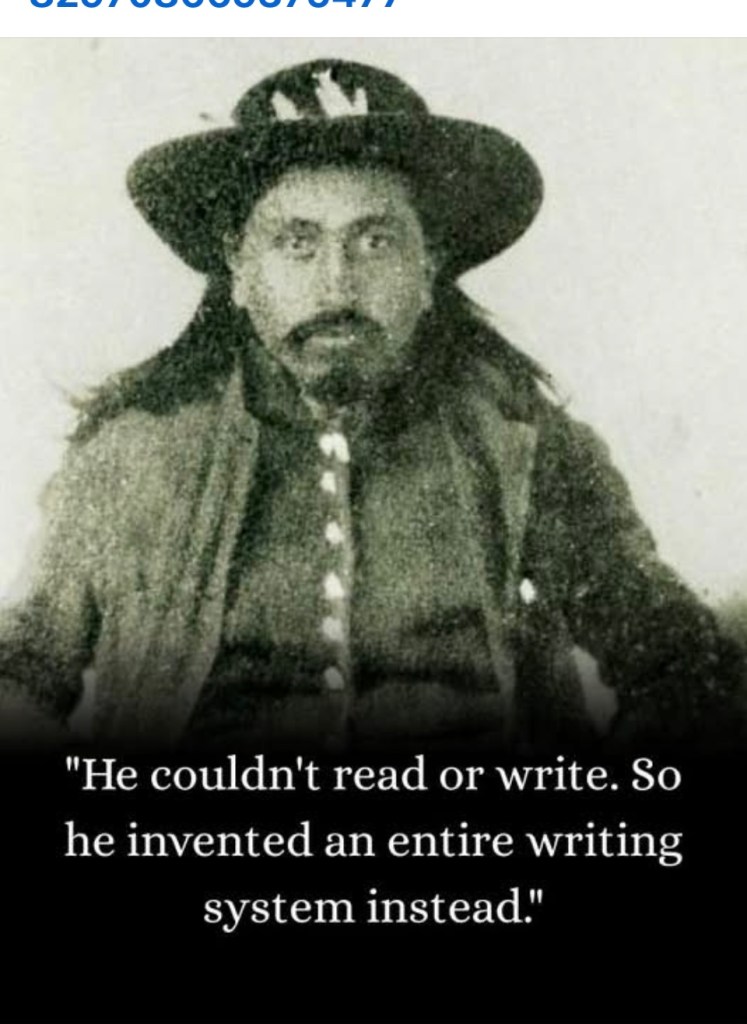
November is Native American Heritage month and I can think of no better way of honoring that than to take note of an extraordinary man who changed the history of the Cherokee nation forever.
During the War of 1812 in which he was a combatant, a Cherokee silversmith named Sequoyah was astonished to see his fellow (white) soldiers delivering messages on sheets of paper, or ‘talking leaves’ as he called them. It must have seemed like magic since the Cherokee had no written language. It was completely outside his range of experience. No one he knew could read or write. He never heard of anything like reading or writing. But he quickly understood the basic concept of a written or symbolic language and its significance.
For the next twelve years he set about devising a written language for the Cherokee, trying symbols for words, pictographs, and so on; finally settling on 86 symbols to represent all the distinct sounds or syllables in the Cherokee language.
He taught the language first to his daughter, Ayoka; and then presented it to tribal chiefs and council leaders in 1821 by keeping his daughter in another room and then having her read their messages perfectly without having heard them. The tribal leaders were stunned and recognized the value of Sequoyah’s syllabary immediately. They adopted his symbols as their written language. Astonishingly, within months thousands of Cherokee people learned to read and write their language, surpassing the literacy rate of English-speaking settlers of the time.
By 1825 much of the Cherokee nation was literate; by 1827 they had their own written constitution and laws; by 1828 they published their first newspaper, the Cherokee Phoenix, both in English and in Cherokee. Sadly, none of this prevented the infamous Trail of Tears in 1838, which deprived them of their lands, their possessions, and for many, their lives. And yet, thanks to an illiterate, although obviously brilliant man named Sequoyah, they could never be deprived of their history, their identity, their records, or their language.
Even today linguists around the world consider his system, called a syllabary because it is based on syllables, and astonishing accomplishment. Just think of it. One man with no education and no resources; he was not literate in any other language, so he had no models. He had only the concept.
One man working alone for twelve years developed a written language so elegant and intuitive that thousands of people learned it in months. That never happened before or since. It is one of the most remarkable intellectual achievements in human history.
Happy Native America Heritage Month!!
*fun fact: The Austrian botanist Stephen Endlicher was so impressed with Sequoyah’s enormous accomplishment, that he named the giant redwoods in California after him
 P.G. Smith Author
Leave a comment